
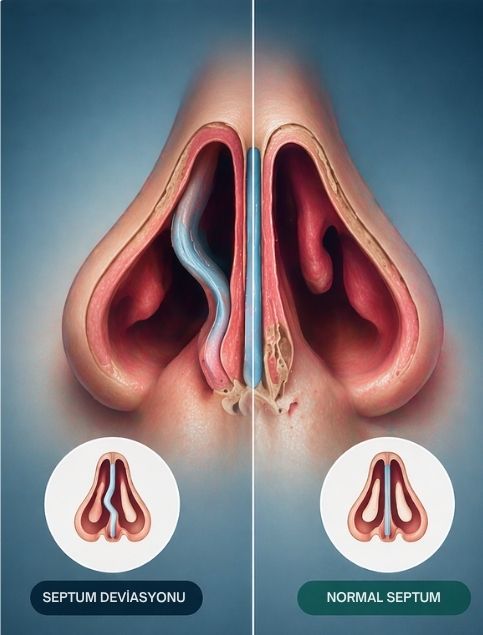
Septum deviation is the displacement of the cartilage and bone structure (septum) that divides the inside of the nose into two parts from the midline. This curvature may affect airflow inside the nose and lead to breathing problems. The septum may not be perfectly straight in every individual, but symptoms become more noticeable in cases of significant deviation.
Nasal deviation may be congenital in some individuals, while in others it may occur due to trauma or changes during the development process. Depending on the degree of curvature, nasal obstruction, unilateral difficulty breathing, or breathing problems that worsen at night may occur.
Septum deviation is not only a structural condition inside the nose but also a problem that can affect quality of life. Therefore, in cases that cause symptoms, evaluation and appropriate treatment planning are important.
What Is Nasal Septum Deviation?
Nasal septum deviation refers to the curvature of the septum structure that divides the nasal cavity into right and left sides. This structure consists of both cartilage and bone and is normally expected to be positioned in the midline. However, in some individuals, it may shift to one side and narrow the airway inside the nose.
Septum curvature may not cause symptoms when mild. However, as the deviation increases, airflow inside the nose may become difficult and breathing problems may arise. This is often experienced as unilateral nasal obstruction.
In individuals with nasal septum deviation, complaints may increase over time due to the imbalance of airflow inside the nose. Therefore, if nasal obstruction persists for a long time, underlying structural causes should be evaluated.
What Causes Septum Deviation?
Septum deviation may occur due to different causes and is often a condition in which more than one factor plays a role. This curvature may be present from birth in some individuals, while in others it may develop later in life.
Congenital septum deviation may occur when the septum does not settle in the midline during the development of the nasal structure. Differences in the growth rates of bone and cartilage structures during childhood and adolescence may also lead to curvature over time.
One of the most common causes of acquired septum deviation is trauma. Blows to the nose, sports injuries, or accidents may cause displacement of the septum structure. In such cases, the deviation may sometimes be noticed immediately, while in other cases it may become apparent over the years. The main conditions that may lead to septum deviation include:
- Congenital differences in nasal structure
- Mismatch of bone and cartilage during development
- Nasal trauma and impacts
- Previous nasal surgeries
The curvature caused by these factors may affect airflow inside the nose and lead to breathing problems over time.
What Are the Symptoms of Septum Deviation?
Septum deviation may not cause symptoms. When the curvature is mild, the individual may not feel any complaints. However, as the deviation increases, airflow inside the nose becomes difficult and various symptoms may occur.
The most common symptom is nasal congestion. This congestion is usually felt on one side, but in some cases it may affect both nostrils. It may become more noticeable especially when lying down or at night. Symptoms that may be seen in individuals with septum deviation include:
- Unilateral or bilateral nasal congestion
- Difficulty breathing
- Habit of mouth breathing
- Snoring at night
- Dryness or crusting inside the nose
- Frequent sinusitis attacks
In some individuals, the imbalance of airflow inside the nose may also cause headaches. In addition, long-lasting nasal congestion may negatively affect sleep quality. The severity of symptoms depends on the degree of septum deviation and the condition of other structures inside the nose.
How Does Septum Deviation Affect Breathing?
Septum deviation may directly affect breathing by narrowing the airway inside the nose. Normally, the air passing through the nose flows evenly on both sides. However, when there is septum curvature, this balance is disrupted and airflow may significantly decrease on one side.
This condition causes a feeling of difficulty especially when breathing through the nose. The person usually notices that one nostril is more open while the other is constantly blocked. This may vary during the day but becomes more noticeable at night or during conditions such as colds. Disruption of airflow inside the nose may lead to:
- Inadequate airflow through the nose
- Development of mouth breathing habit
- Snoring or interrupted breathing during sleep
- Feeling of fatigue during the day
Long-term breathing problems may affect sleep quality and daily life. Therefore, it is important to evaluate individuals experiencing breathing difficulty due to septum deviation.
How Is Septum Deviation Diagnosed?
Septum deviation is evaluated based on the patient’s complaints and physical examination. The most common reasons for consultation are nasal congestion and breathing problems. Based on these complaints, the internal nasal structures need to be examined in detail.
During the examination, the inside of the nose is evaluated using special instruments. This allows observation of how much the septum deviates from the midline and how much it narrows the airway. If necessary, endoscopic methods may be used for more detailed evaluation, allowing clearer visualization of internal nasal structures.
In some cases, especially if accompanying conditions such as sinusitis are suspected, imaging methods may also be used. This allows evaluation not only of the septum deviation but also of other nasal structures.
The diagnosis process of septum deviation focuses not only on the presence of deviation but also on whether it causes symptoms in the patient. Because not every septum deviation requires treatment. In cases causing symptoms, an appropriate treatment plan is determined.
How Is Septum Deviation Treated?
Septum deviation treatment is planned according to the degree of curvature and the symptoms it causes in the patient. Not every septum deviation requires treatment. If it does not cause significant breathing problems, follow-up may be sufficient. However, if there is nasal congestion, frequent sinusitis attacks, or breathing difficulty affecting quality of life, treatment is considered.
Non-surgical approaches are mainly aimed at relieving symptoms. Supportive treatments that reduce nasal dryness and relax the mucosa may provide temporary relief in some patients. However, these methods do not correct the septum deviation.
The main treatment method for significant symptoms is septoplasty surgery. In this procedure, the curved cartilage and bone structures inside the nose are corrected to open the airway. The procedure is usually performed through incisions inside the nose, so no visible external scar occurs. During the surgery:
- Cartilage and bone parts causing the deviation are corrected
- They are reshaped and repositioned if necessary
- The nasal airway is made more balanced
Septoplasty is a procedure aimed only at improving breathing function. However, in some patients, rhinoplasty may also be planned in the same session. In this case, both functional and aesthetic corrections are performed together.
What Is the Recovery Process After Septum Deviation Surgery?
The recovery process after septum deviation surgery (septoplasty) generally progresses gradually and may vary depending on the patient’s nasal structure. After the surgery, the tissues inside the nose begin to heal, and some temporary complaints may occur during this process.
In the first days after the surgery, a feeling of fullness, mild congestion, and sensitivity in the nose may occur. This is usually caused by edema inside the nose. In some patients, supportive materials or nasal packs may be used for a short time. During the first week, the healing process inside the nose accelerates. During this period:
- Swelling inside the nose gradually decreases
- Breathing may not be fully comfortable at first but improves over time
- Returning to daily life becomes possible
After the first week, nasal tissues continue to recover. In the second and third weeks, breathing becomes more comfortable. However, complete healing of the internal nasal tissues may take several weeks. Some important points during recovery include:
- Avoiding movements that may put pressure on the nose
- Avoiding forceful nose blowing for a while
- Following intranasal care recommendations
- Postponing heavy physical activities
Recovery after septoplasty is generally comfortable. Improvement in breathing becomes more noticeable as healing progresses.
Yasal Uyarı:
Her cerrahi veya girişimsel işlemde sonuçlar kişiden kişiye değişiklik gösterebilir. İşlem öncesinde hekiminizden detaylı görüş almanız önerilir.