

Nasal Congestion
Nasal congestion is a condition in which breathing through the nose becomes difficult or completely blocked....
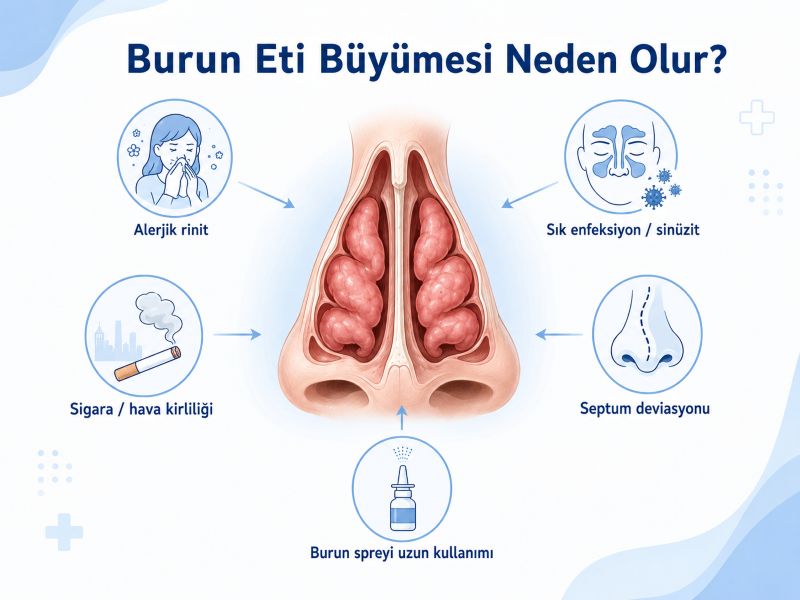
Nasal turbinate enlargement is a condition in which breathing through the nose becomes difficult as a result of the turbinates inside the nose swelling or increasing in volume more than normal. Turbinates are natural structures that warm, humidify and filter the air passing through the nose. However, when they enlarge due to allergies, infections, environmental irritants or structural nasal problems, they may narrow the airway and cause nasal congestion.
Turbinates are normally necessary structures for nasal health. Therefore, not every turbinate enlargement is considered a condition that “must be completely removed.” The aim of treatment is to relieve airflow inside the nose while preserving the natural function of the turbinates as much as possible.
One of the most common answers to the question what causes nasal turbinate enlargement is allergic rhinitis. Sensitivity to pollen, house dust, animal dander, mold or certain chemical odors may cause persistent edema and swelling inside the nose. Over time, this may make the turbinates more prominent.
Frequent upper respiratory tract infections, chronic sinusitis, cigarette smoke, air pollution, dry air and some occupational exposures may also lead to turbinate enlargement. In some patients, one turbinate may enlarge compensatorily due to a curvature in the middle part of the nose, known as septum deviation.
Long-term and uncontrolled use of nasal decongestant sprays may also cause a persistent feeling of swelling in the nasal tissues. In this case, the patient feels temporary relief after using the spray, but nasal congestion may become more noticeable as the effect of the medication wears off.
Among the symptoms of nasal turbinate enlargement, the main complaint is difficulty breathing through the nose. Congestion may be one-sided or bilateral. In some patients, complaints increase at night, while in others they continue throughout the day.
Nasal turbinate enlargement may be seen with the following symptoms:
These symptoms are not seen with the same severity in every patient. Some people experience noticeable congestion only during seasonal changes, while others may have a year-round nasal breathing problem.
Yes, turbinate enlargement is one of the common causes of nasal congestion. Since the turbinates are located close to the air passage inside the nose, they may narrow the nasal passage when they enlarge. This narrowing may be felt more noticeably, especially when lying down at night.
Nasal congestion may not be caused only by turbinate enlargement. Septum deviation, nasal polyps, allergic rhinitis, sinusitis or deformities in the external nasal structure may also cause similar complaints. Therefore, before planning treatment, the main cause of congestion should be correctly identified.
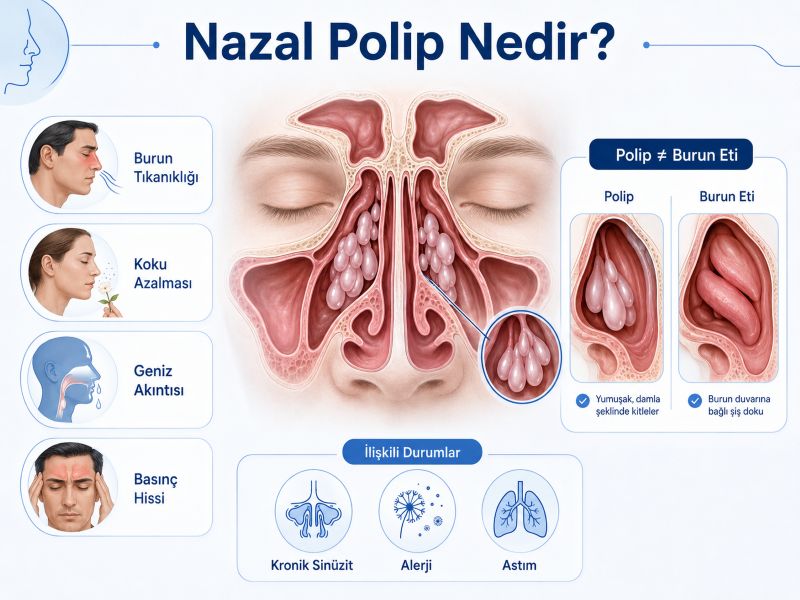
A nasal polyp is a soft-tissue and usually benign formation that develops from the mucosa lining the inside of the nose and sinuses. Polyps may narrow the airflow inside the nose, impair sinus ventilation and cause long-term nasal congestion.
Nasal polyps may especially be seen together with chronic sinusitis, allergic tendency, asthma or certain sensitivity conditions. In addition to nasal congestion, patients may experience reduced sense of smell, postnasal drip, facial pressure and recurrent sinus infections.
Polyps may be confused with nasal turbinate enlargement. However, the turbinate is a normal anatomical structure found inside the nose, whereas a nasal polyp is a different tissue formation that develops from the nasal or sinus mucosa. This distinction is clarified during examination.
Nasal turbinate enlargement and nasal polyps are not the same condition. The nasal turbinate, also called the concha, is a natural nasal structure present in everyone. Its function is to regulate, humidify and filter inhaled air. When this structure swells or enlarges due to certain reasons, turbinate hypertrophy occurs.
A nasal polyp, on the other hand, is a soft tissue formation that develops later inside the nose. Polyps may block the nasal passage and are especially associated with smell problems. Therefore, the treatment approach is different. In turbinate enlargement, medical treatment, allergy control or turbinate reduction procedures may be considered; in nasal polyps, medication, follow-up or endoscopic sinus surgery may be evaluated in suitable patients.
| Feature | Nasal Turbinate Enlargement | Nasal Polyp |
|---|---|---|
| Structure | Enlargement of the turbinate naturally found inside the nose | Soft tissue formation developing from the nasal or sinus mucosa |
| Main complaint | Nasal congestion and difficulty breathing | Nasal congestion, loss of smell and postnasal drip |
| Commonly associated conditions | Allergic rhinitis, septum deviation, infections | Chronic sinusitis, asthma, allergic tendency |
| Treatment approach | Medication, allergy control, turbinate reduction | Medication, follow-up, endoscopic sinus surgery in suitable patients |
In the diagnosis of nasal turbinate enlargement, the patient’s complaints are first evaluated in detail. How long nasal congestion has been present, whether it is one-sided or bilateral, whether it changes seasonally and whether it is accompanied by allergy symptoms are questioned.
During the ear, nose and throat examination, the internal nasal structures are examined. When necessary, an endoscopic nasal examination may be performed. With this examination, turbinate enlargement, septum deviation, nasal polyps, adenoids, sinusitis findings or other structural problems inside the nose can be evaluated more clearly.
In some patients, sinus tomography, allergy tests or additional examinations may be required. A more detailed evaluation is especially important if nasal polyps are suspected, chronic sinusitis findings are present or long-term one-sided congestion continues.
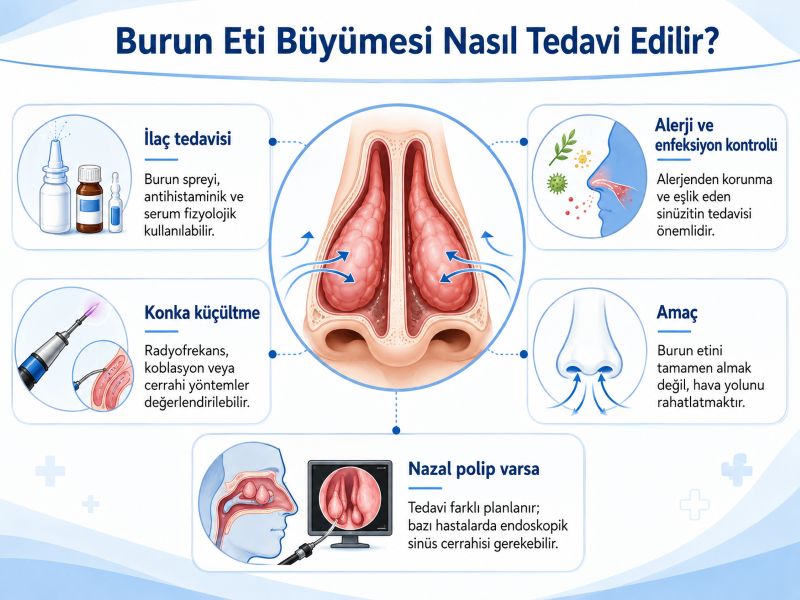
Treatment of nasal turbinate enlargement is planned according to the cause of the enlargement and the patient’s complaints. In turbinate enlargement due to allergy, nasal sprays, antihistamine medications, saline nasal rinses and measures to avoid allergens may be helpful. If infection or sinusitis accompanies the condition, treatment may be arranged accordingly.
If nasal congestion continues despite medication, turbinate reduction procedures may be considered. Radiofrequency, coblation or surgical reduction methods may be applied in suitable patients. The aim here is not to completely remove the turbinate, but to reduce its volume in a way that relieves the airway.
If nasal polyps accompany the condition, treatment is planned differently. The extent of nasal polyps, how they affect the sinus cavities, the changes they cause in smell function and the response to previous treatments are evaluated together. In some patients, medication may be sufficient, while in others endoscopic sinus surgery may be required.
Yasal Uyarı:
Her cerrahi veya girişimsel işlemde sonuçlar kişiden kişiye değişiklik gösterebilir. İşlem öncesinde hekiminizden detaylı görüş almanız önerilir.
Nasal congestion is a condition in which breathing through the nose becomes difficult or completely blocked....

Sinusitis is an ENT condition that may cause symptoms such as nasal congestion, postnasal drip, facial pain, and a reduced sense of smell du...