

Nasal Turbinate Enlargement (Concha)
Nasal turbinate enlargement is a condition in which breathing through the nose becomes difficult as a result of the turbinates inside the no...
Nasal congestion is a condition in which breathing through the nose becomes difficult or completely blocked. This complaint may occur during a short-term cold, or it may continue for a long time due to nasal septum deviation, nasal turbinate enlargement, allergies, sinusitis or structural nasal problems. Persistent nasal congestion may affect not only breathing, but also sleep quality, sense of smell, dry mouth and daily comfort.
The nose is an important organ that warms, humidifies and filters the air we breathe. When enough air cannot pass through the nose, a person may begin breathing through the mouth. This may lead to problems such as snoring during sleep, throat dryness, waking up tired in the morning and difficulty concentrating. Therefore, nasal congestion should not be considered only as a simple breathing problem.
The answer to the question what causes nasal congestion is not the same for every patient. In some people, the problem is caused by temporary swelling inside the nose, while in others structural narrowing is more prominent. One of the most common causes is nasal septum deviation, known as septum deviation. Curvature of the cartilage or bone structure in the middle part of the nose may make airflow difficult on one or both sides.
Nasal turbinate enlargement is also among the common causes. Nasal turbinates normally help humidify and warm the air. However, when they enlarge due to allergies, chronic infections, environmental irritants or structural causes, they may narrow the nasal passage.
Allergic rhinitis is one of the causes of nasal congestion, especially when it is seasonal or persists throughout the year. Sensitivity to dust, pollen, animal dander, mold or chemical odors may present with runny nose, sneezing, itching and congestion. Sinusitis, nasal polyps and previous nasal trauma are other conditions that may cause congestion.

Symptoms of nasal congestion may occur alone or together with different complaints. These accompanying symptoms are important for understanding the underlying cause.
An ear, nose and throat examination should not be delayed, especially in cases of one-sided, long-lasting or gradually worsening nasal congestion. In some patients, the congestion may be related to a simple allergy, while in others an intranasal mass, polyp or advanced structural narrowing may be present.
Nasal congestion may directly affect sleep quality. People who cannot get enough air through the nose tend to breathe through the mouth throughout the night. This may cause complaints such as snoring, dry mouth, frequent waking and feeling unrested in the morning.
In some patients, nasal congestion may make breathing problems during sleep more noticeable. Especially if symptoms such as snoring, daytime sleepiness, morning headache and attention problems are present, the effect of nasal congestion on sleep should be evaluated in detail.
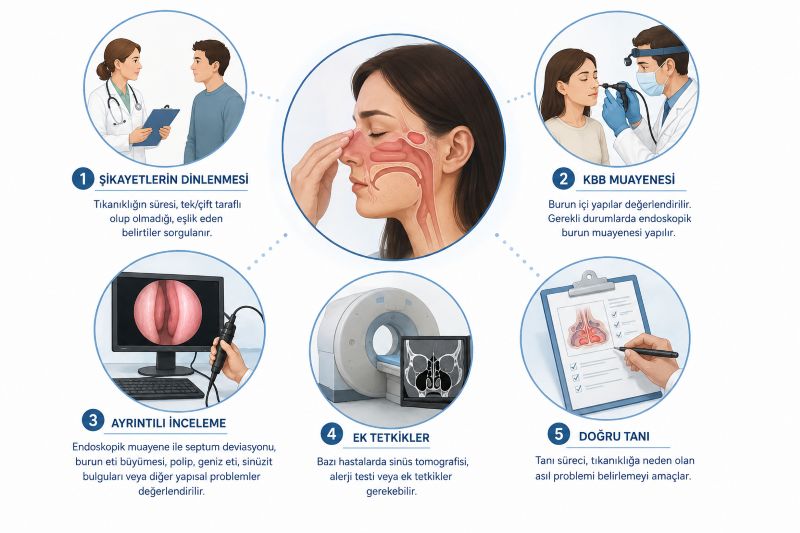
The first step in the diagnosis of nasal congestion is listening to the patient’s complaints in detail. How long the congestion has been present, whether it is felt on one side or both sides, whether it changes seasonally and whether it is accompanied by runny nose or sneezing are questioned.
During an ear, nose and throat examination, the structures inside the nose are evaluated. When necessary, an endoscopic nasal examination may be performed. With this method, the inside of the nose is examined in more detail; septum deviation, nasal turbinate enlargement, polyps, adenoids, sinusitis findings or other structural problems can be seen more clearly.
In some patients, sinus tomography, allergy evaluation or additional tests may be required. The diagnostic process aims not only to identify the presence of congestion but also to determine the actual problem causing it.
Treatment of nasal congestion is planned according to the underlying cause. Not every nasal congestion requires surgery. In conditions such as allergy, infection or intranasal edema, medications, nasal sprays, saline applications and environmental measures may be sufficient.
However, if there is nasal septum deviation, significant nasal turbinate enlargement, nasal polyps or structural narrowing, medical treatments may not provide permanent relief. In this case, surgical options may be evaluated.
In septum deviation, the curved structure inside the nose is corrected with septoplasty surgery. In nasal turbinate enlargement, radiofrequency or surgical reduction methods may be applied. If there is curvature or collapse in the external nasal structure that affects breathing, functional nasal surgery may be considered.
The decision for surgery for nasal congestion is not made only because the patient says, “my nose is blocked.” Examination findings, intranasal airway narrowing, duration of complaints, response to medical treatments and the effect on the patient’s daily life are evaluated together.
Surgical options may be considered in the following situations:
Surgical planning should be personalized. This is because the location, cause and severity of congestion differ in each patient.

If nasal congestion continues for a long time, it should not be managed only with temporary sprays. Especially uncontrolled use of nasal decongestant sprays may create an addiction-like effect in the nasal tissues and increase congestion. Therefore, in persistent or recurrent nasal congestion, evaluation by an ear, nose and throat specialist is important.
Yasal Uyarı:
Her cerrahi veya girişimsel işlemde sonuçlar kişiden kişiye değişiklik gösterebilir. İşlem öncesinde hekiminizden detaylı görüş almanız önerilir.
Nasal turbinate enlargement is a condition in which breathing through the nose becomes difficult as a result of the turbinates inside the no...