

Failed rhinoplasty refers to a condition in which the result achieved after rhinoplasty does not meet expectations aesthetically and, in some cases, leads to functional problems. The inability to preserve a natural appearance after nose surgery, the development of irregularities in the nasal structure, or the emergence of breathing problems can be given as examples of this condition.
After rhinoplasty, the healing process must be completed in order to fully evaluate the shape of the nose. In the first months, the nose may appear different because of swelling. For this reason, it is generally necessary for the healing process to be largely completed before describing the result as unsuccessful.
Failed rhinoplasty is not limited to appearance alone. Structural changes inside the nose may also affect breathing function. In this case, functional problems may occur in addition to aesthetic concerns.
When such situations are evaluated, both the aesthetic appearance and nasal functions are considered together. If necessary, a personalized revision rhinoplasty plan can be created.
How Can Failed Rhinoplasty Be Recognized?
In order to evaluate the result after rhinoplasty, the healing process must be largely completed. In the first months, the shape of the nose may appear temporarily different because swelling and tissue healing are still ongoing. For this reason, evaluations made in the early period may be misleading.
Failed rhinoplasty usually shows itself through both irregularities in appearance and functional problems. While expecting a better result than before surgery, the person may notice a loss of natural appearance in the nose, imbalance, or difficulty breathing. The most common findings are as follows:
- Irregularity or collapse on the nasal bridge
- Noticeable drooping or loss of shape in the nasal tip
- Crookedness or an asymmetrical appearance of the nose
- Differences in the nostrils
- Difficulty breathing
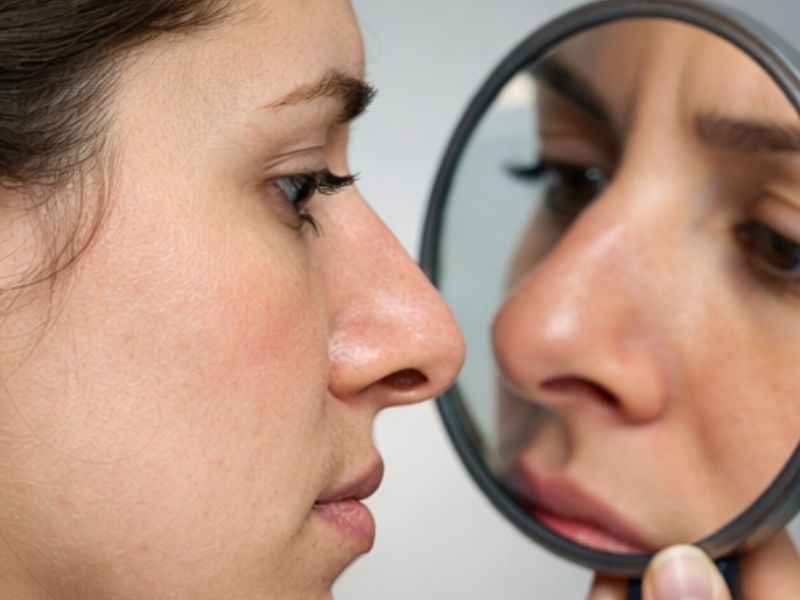
In some cases, even issues that seem minor aesthetically may become more noticeable in profile view. In addition, structural changes inside the nose may lead to breathing problems even in a nose that appears aesthetically satisfactory.
For this reason, when failed rhinoplasty is evaluated, not only the external appearance but also nasal functions should be considered together.
What Problems Can Be Seen After Failed Rhinoplasty?
Problems that arise after failed rhinoplasty are generally evaluated in two main groups: issues related to aesthetic appearance and conditions that affect nasal function. This distinction helps the problem to be understood more accurately.
From an aesthetic point of view, unexpected changes in the nasal structure may attract attention. Conditions such as irregularities on the nasal bridge, imbalance in profile view, or loss of shape in the nasal tip may disrupt harmony with the face. Such changes may become especially more noticeable in light or from the side view.
From a functional perspective, the effect on airflow inside the nose comes to the forefront. Inadequate support inside the nose or narrowing of the airway may make breathing difficult. While this may only be felt during exertion in some patients, it may affect daily life in others.
Apart from this, some conditions related to the healing process may also turn into problems over time. In particular, uneven tissue healing may cause small but noticeable changes in the nasal structure.
Is Nasal Tip Drooping a Sign of Failed Rhinoplasty?
Nasal tip drooping is one of the most frequently wondered-about issues after rhinoplasty. However, this does not always mean failed rhinoplasty. Mild changes seen in the early postoperative period are often part of the healing process.
During rhinoplasty, the nasal tip is supported with cartilage structures. As swelling decreases and the tissues settle during the healing process, a slight downward movement in the nasal tip may be seen. This is generally considered part of the planned natural appearance and is accepted as normal up to a certain level.
However, a clearly drooping nasal tip that negatively affects the aesthetic appearance is a different situation. Such cases are generally related to insufficient support provided to the nasal tip, weakness of the cartilage structure, or changes that occur during the healing process. Nasal tip drooping should be evaluated more carefully in the following situations:
- A noticeable downward positioning of the nasal tip after surgery
- Imbalance in profile view
- The nasal tip appearing aesthetically different from what was expected
In such cases, the healing process is expected to be completed first, and then an evaluation is made. If necessary, the nasal tip can be reshaped with revision rhinoplasty.
Why Do Asymmetry And Shape Deformities Occur After Nose Surgery?
Asymmetry or shape deformity seen after rhinoplasty is often related more to the healing process than to the surgery itself. While the nasal tissues are reshaping after surgery, healing may not occur at the same rate in every area. This may lead to a different appearance in some parts.
In particular, the response of the cartilage and bone structures inside the nose during healing may affect the nasal form. Tissue tension, skin thickness, and the healing pattern may create small differences on the nasal surface. For this reason, asymmetries seen in the early period after nose surgery are not always permanent.
Another important point is pre-existing facial asymmetry before surgery. Since the face is not completely symmetrical, these differences may become more noticeable after rhinoplasty. In most cases, this is not related to the surgery but is a natural result of the facial structure.
In addition, swelling that does not distribute equally on both sides during healing may also lead to temporary shape differences. For this reason, it is more accurate to evaluate the shape of the nose not in the early period, but after the healing process has been completed. In cases of clearly persistent asymmetry, the nasal structure is re-evaluated.
When Is Revision Performed After Failed Rhinoplasty?
Before planning revision after failed rhinoplasty, the most important point is to wait for the healing process to be completed. After nose surgery, it takes time for the tissues to settle fully, and evaluations made in the early period may be misleading. For this reason, in most cases it is recommended to wait for a certain period before revision.
In the first months after surgery, swelling, firmness, and shape changes may be seen in the nose. During this process, the nasal form changes gradually. Therefore, it is usually necessary to wait several months to evaluate the final result. This period is important for the nasal tissues to heal and take their final form. Revision rhinoplasty generally comes to the agenda in the following situations:
- If a noticeable aesthetic irregularity persists
- If there is permanent crookedness or asymmetry in the nasal structure
- If breathing problems continue
- If unwanted changes have occurred in the nasal tip or nasal bridge
When planning revision surgery, the current nasal structure is first evaluated in detail. As a result of this evaluation, the areas that need correction are determined and a personalized surgical plan is created. Revision rhinoplasty is a process that requires more careful planning than the first surgery. For this reason, correct timing, planning, and expectation management are important.
Failed Rhinoplasty FAQ
Can failed rhinoplasty be recognized immediately?
It may be difficult to make a definite evaluation in the first weeks and months after surgery, as swelling and tissue healing in the nose are still ongoing. The shape of the nose changes over time. Therefore, the healing process must be largely completed to understand the final result.
How can swelling be distinguished from a permanent problem after rhinoplasty?
Swelling usually appears as general fullness and puffiness in the nose and gradually decreases over time. Permanent problems, on the other hand, present as persistent irregularities, curvature, or breathing difficulties in specific areas. This distinction usually becomes clearer within a few months.
Can failed rhinoplasty cause breathing difficulties?
Yes, narrowing of the airway inside the nose, insufficient cartilage support, or involvement of the nasal valve area may make breathing more difficult. This condition may become noticeable in some patients after surgery.
Why does the nasal tip drop after rhinoplasty?
The supporting structures of the nasal tip are reshaped during surgery. If sufficient support is not provided, or due to the effects of tissue healing, a downward change in the nasal tip may occur. Mild changes can also be part of the natural healing process.
How long should one wait before revision rhinoplasty?
Before planning revision, it is necessary to wait for the nasal tissues to heal. In the early period, the shape of the nose has not fully settled. This duration may vary depending on the nasal structure and healing process, and evaluation is usually done after a certain period of time.
Is deformity after rhinoplasty always permanent?
Some irregularities seen in the early period after surgery may be related to swelling and tissue healing. These changes may improve over time. Whether they are permanent becomes clearer as the healing process progresses.
Is revision rhinoplasty more difficult than the first surgery?
In revision procedures, the nasal tissues have already been operated on, so surgical planning must be more careful. Since existing structures need to be preserved and reshaped, the process may be more detailed.
Can every problem in failed rhinoplasty be corrected with surgery?
Surgical intervention may not be necessary in every case. Some minor irregularities may improve over time or be managed with alternative methods. When necessary, revision rhinoplasty can be planned.
Yasal Uyarı:
Her cerrahi veya girişimsel işlemde sonuçlar kişiden kişiye değişiklik gösterebilir. İşlem öncesinde hekiminizden detaylı görüş almanız önerilir.